
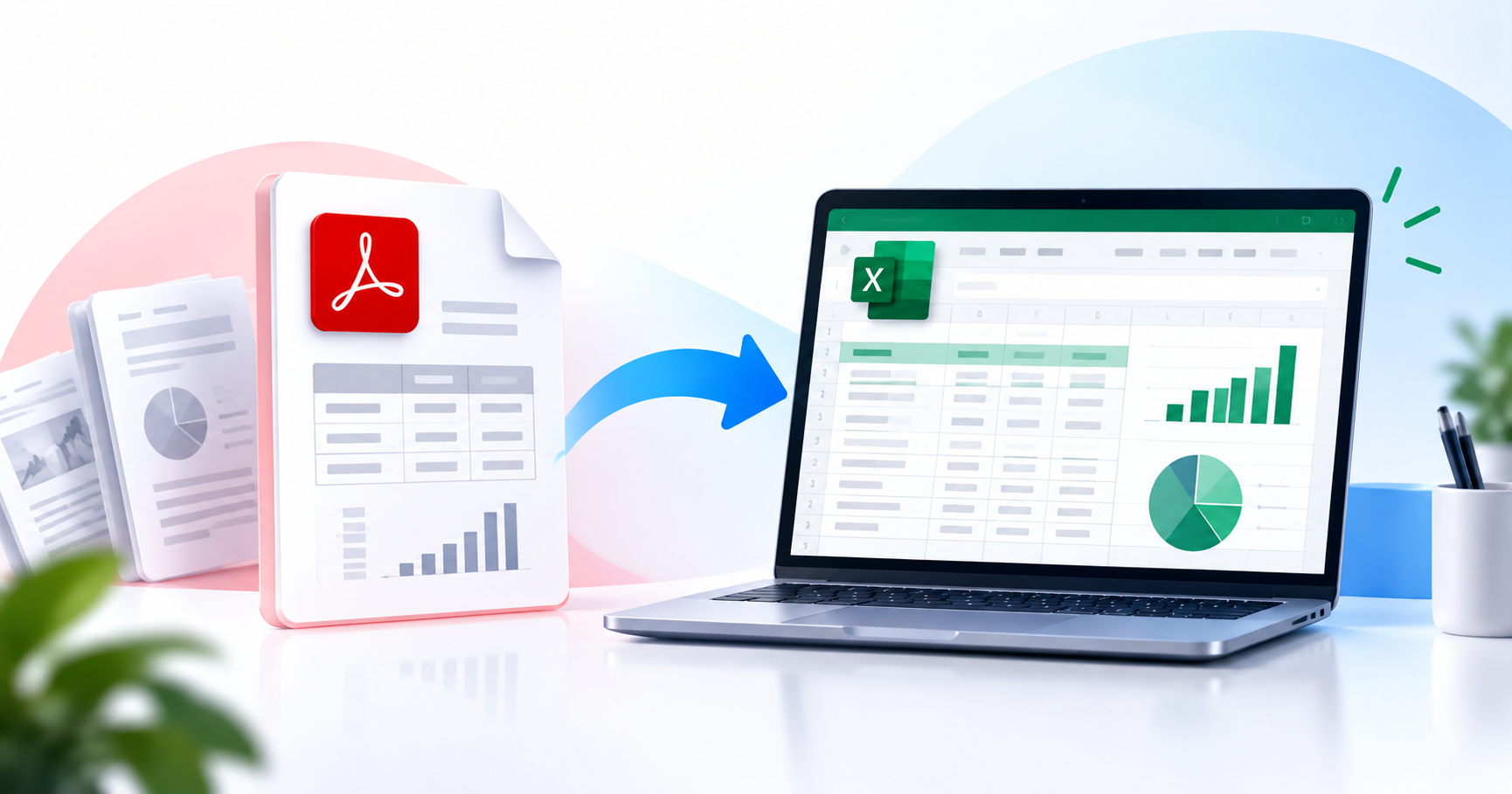
PDF files are excellent for sharing reports, invoices, statements, price lists, and business documents.
They are not always convenient when you need to work with the data inside them.
Imagine receiving a 30-page PDF containing financial tables.
You need those numbers in Excel so you can sort them, apply formulas, filter rows, compare values, or build a report.
The traditional approach is simple:
Open the PDF.
Open Excel.
Copy one row.
Paste it.
Fix the formatting.
Repeat.
And repeat again.
That may be manageable for one small table, but it quickly becomes frustrating when a PDF contains dozens of rows, multiple columns, or several pages of structured data.
A PDF to Excel converter offers a much more practical workflow.
Instead of manually rebuilding tables, you can convert the PDF into an editable spreadsheet and continue working with the data in Excel.
In this guide, we will look at how PDF-to-Excel conversion works, when it is useful, what problems manual copy-paste creates, how scanned documents are different, and how to get cleaner spreadsheet results.
If you need to process a document, you can start from PDFPilot4U and select the PDF to Excel tool.
Why Copying Tables from PDF to Excel Is Difficult
At first glance, a PDF table may look exactly like a spreadsheet.
It has rows.
It has columns.
It has numbers.
It may even look as if the data should copy perfectly into Excel.
But PDFs are primarily designed to preserve how a document looks.
Excel is designed to work with structured data.
That difference creates problems.
When you manually copy a table from PDF, you may end up with:
- Multiple columns pasted into one cell
- Broken rows
- Missing values
- Numbers treated as text
- Unwanted line breaks
- Repeated headers
- Misaligned columns
- Lost table structure
You may spend more time cleaning the spreadsheet than extracting the information.
This is why PDF table extraction is different from normal text copying.
Manual Copy-Paste vs PDF to Excel Conversion
| Task | Manual Copy-Paste | PDF to Excel |
|---|---|---|
| Large tables | Time-consuming | Much easier |
| Multiple pages | Repetitive | Can be processed together |
| Row structure | May break | Better chance of staying organized |
| Columns | Often misaligned | Structured spreadsheet output |
| Scanned PDF | Usually cannot copy directly | OCR may be needed |
| Editing data | Requires cleanup first | Data becomes spreadsheet-ready |
| Sorting & filtering | Manual preparation | Easier after conversion |
| Repeated documents | Poor workflow | More scalable |
Manual copying still works for very small tables.
But once documents become longer, converting the PDF usually makes more sense.
What Is PDF to Excel Conversion?
PDF to Excel conversion is the process of taking structured information from a PDF and turning it into a spreadsheet format that can be edited.
For example, imagine a PDF containing:
| Product | Quantity | Price |
|---|---|---|
| Product A | 10 | 250 |
| Product B | 15 | 400 |
| Product C | 8 | 300 |
Inside the PDF, this is primarily visual information.
After converting it to Excel, you can work with those values like normal spreadsheet data.
You can:
Sort by price.
Filter products.
Calculate totals.
Create charts.
Add formulas.
Compare periods.
Build reports.
This is the real value of PDF to Excel conversion.
It does not simply change the file extension.
It makes the information more usable.
When Is PDF to Excel Useful?
There are many situations where tables are delivered as PDFs even though the next step requires spreadsheet analysis.
Bank Statements
Bank and financial statements often contain dates, transaction descriptions, debit values, credit values, and balances.
If you need to categorize transactions or reconcile data, manually entering each row into Excel is inefficient.
Converting the statement can provide a better starting point.
Always review financial data after conversion before using it for accounting or reporting.
Invoices
Invoices may contain structured line items such as:
Product name
Quantity
Unit price
Tax
Discount
Total
For one invoice, manual entry may be manageable.
For dozens of invoices, it becomes repetitive.
Moving table data into Excel can make comparison and analysis much easier.
Financial Reports
Annual reports and financial documents often include:
Revenue tables
Expense breakdowns
Quarterly performance
Balance sheets
Cash-flow information
Year-over-year comparisons
Analysts may need those values in a spreadsheet before they can perform further analysis.
Product Catalogs
A supplier may send pricing information as a PDF.
The catalog could contain hundreds of products.
Converting pricing tables into a spreadsheet makes it easier to:
Compare items.
Filter categories.
Calculate margins.
Update prices.
Prepare internal reports.
Research Data
Research papers and reports often contain useful tables.
Students, analysts, and researchers may need to reorganize that information for further study.
Instead of manually typing the table again, extraction can save time.
Business Reports
Sales reports, inventory reports, operational reports, and supplier summaries are often distributed as PDF documents because the format is easy to share.
But if the receiving team needs to analyze those numbers, Excel becomes more useful.
That is where PDF-to-Excel conversion fits naturally.
How to Convert PDF Tables to Excel
The process is straightforward.
Step 1: Check the PDF
Open the document first.
Identify where the table appears.
Check whether the text can be selected.
If you can select individual words and numbers, the PDF is probably digitally generated.
If every page behaves like one large image, it may be scanned.
This distinction matters.
Step 2: Open a PDF to Excel Tool
Open PDFPilot4U and choose PDF to Excel from the conversion tools.
Upload the document you want to process.
Step 3: Convert the Document
The converter analyzes the table structure and prepares spreadsheet output.
Complex documents may require more review than simple tables.
A clean financial table with obvious rows and columns is generally easier to process than a visually complicated report containing sidebars, graphics, footnotes, and several different layouts.
Step 4: Open the Excel File
Once the conversion is complete, open the resulting spreadsheet.
Do not immediately assume that every value is correct.
Check the important columns and totals.
Step 5: Clean the Data
Depending on the original PDF, you may need to:
Rename headings.
Remove unnecessary rows.
Check date formatting.
Convert text values to numbers.
Recreate formulas.
Merge related sheets.
Correct unusual characters.
This is still much faster than manually rebuilding a large table from scratch.
What About Scanned PDFs?
This is an important difference.
A normal digital PDF contains selectable text.
A scanned PDF may simply contain photographs of pages.
For example, imagine someone printed an invoice, signed it, scanned it, and emailed the scan.
The computer may initially see the page as an image.
Before that information can become spreadsheet data, the text needs to be recognized.
This is where OCR — Optical Character Recognition — becomes useful.
OCR attempts to identify characters inside scanned images.
After the text has been recognized, the data can then be structured into rows and columns.
Scan quality matters.
A clear, straight, high-resolution scan will generally be easier to process than a dark, tilted, blurry photograph.
How to Get Better PDF-to-Excel Results
The converter matters, but the quality of the original document matters too.
Use the Original PDF When Possible
If you have access to the original digital PDF, use that rather than a screenshot.
A screenshot removes a lot of structural information.
Avoid Cropped Table Edges
Make sure columns are fully visible.
If the first or last column is partially cut off, information may be lost.
Use Clear Scans
For scanned documents, check:
- Text is readable
- Page is straight
- Lighting is even
- No fingers cover the page
- Table borders are visible
- Resolution is sufficient
Review Numbers Carefully
This is particularly important for:
Financial data
Tax figures
Account numbers
Invoice totals
Dates
Percentages
An automated conversion should make the workflow faster, but important business decisions should still use verified data.
PDF to Excel vs PDF Data Extraction
These workflows are related, but they solve slightly different problems.
A PDF to Excel converter is useful when the document already contains a table and you want that table in spreadsheet form.
Data extraction becomes more useful when you need specific fields from many different documents.
For example, imagine 100 invoices from different suppliers.
You only want:
Invoice number
Vendor
Invoice date
Tax
Total
Instead of recreating the entire document in Excel, you may want only those fields.
PDFPilot4U also provides document extraction capabilities for structured information.
The workflow you choose should depend on the outcome you need.
Which Workflow Should You Choose?
| Your Goal | Better Approach |
|---|---|
| Turn an existing PDF table into spreadsheet form | PDF to Excel |
| Extract specific fields from many documents | Data extraction |
| Convert a scanned table | OCR + PDF to Excel |
| Analyze a financial table | PDF to Excel |
| Extract invoice number, date, total only | Structured data extraction |
| Ask questions about the document | Ask PDF |
| Summarize the whole report | AI Summarizer |
PDFPilot4U currently includes PDF conversion, OCR, Ask PDF, summarization, and structured extraction workflows within its document-tool platform.
PDF to Excel for Finance Teams
Finance professionals regularly receive data that should logically be in spreadsheets but arrives in PDF form.
Common examples include:
Bank statements
Supplier invoices
Expense reports
Financial reports
Pricing sheets
Account statements
Re-entering this information manually creates two problems.
First, it takes time.
Second, every manually entered number creates another opportunity for human error.
A converted spreadsheet provides a starting point that can then be checked before analysis.
PDF to Excel for Sales Teams
Sales teams may receive:
Price lists
Distributor catalogs
Competitor pricing documents
Commission tables
Sales reports
Once the data is in Excel, it becomes easier to compare:
Products
Regions
Prices
Margins
Periods
Performance
The key benefit is not conversion itself.
It is what you can do with the information afterward.
PDF to Excel for Students and Researchers
PDF is extremely common in academic work.
Research papers, government reports, surveys, and industry publications frequently contain tables.
If you want to analyze those values, copying them manually can become tedious.
Converting a table into spreadsheet form gives you the ability to organize and work with the data more efficiently.
However, always preserve the original source and citation information.
Extracting data does not remove the need to cite where it came from.
PDF to Excel for Operations Teams
Operations teams may work with:
Inventory sheets
Purchase orders
Shipment reports
Vendor tables
Production reports
Stock lists
When data from these documents needs to be compared with internal records, having editable spreadsheet data becomes much more useful than reading a static PDF.
Why Not Just Use Ctrl+C and Ctrl+V?
For a table with three rows?
You probably can.
For a 25-page report with 600 rows?
That approach stops being practical.
Manual copy-paste also makes it difficult to know whether:
A column moved.
A row was skipped.
A value pasted incorrectly.
A number became text.
A page header became part of the data.
This is why automated extraction becomes increasingly valuable as documents grow.
What Should You Check After Conversion?
Before analyzing the spreadsheet, verify the important information.
Check:
Totals against the original PDF.
First and last rows.
Date formats.
Decimal values.
Negative numbers.
Currency symbols.
Blank cells.
Column headers.
If the document contains financial or legal information, perform a more thorough review.
Automation should reduce repetitive work.
It should not remove validation.
Common PDF-to-Excel Problems
Multiple Values Appear in One Cell
This can happen when the original PDF does not have a clear table structure.
Try reviewing the original layout and separating the affected data.
Numbers Are Stored as Text
Excel may not immediately recognize some extracted values as numbers.
You may need to convert the column format before using formulas.
Dates Look Different
PDF documents can contain many date formats.
Examples:
16/09/2026
Sep 16, 2026
2026-09-16
Standardize the Excel column before analysis.
Scanned Text Is Incorrect
OCR can sometimes confuse similar characters.
Examples include:
0 and O
1 and I
5 and S
This is another reason to verify important values.
Tables Span Several Pages
Long tables may contain repeated column headers on every page.
After conversion, you may want to remove the repeated header rows.
Should You Use PDF to Excel or Manually Enter Data?
Think about the size of the task.
For a five-row table, manual entry may be quicker.
For a report containing hundreds of rows, conversion is usually a more sensible starting point.
A simple way to decide is:
If cleaning the converted spreadsheet takes less time than rebuilding the table, convert it.
For most large structured documents, that threshold is reached very quickly.
Final Thoughts
PDFs are excellent for sharing information.
Excel is better when you need to work with that information.
If a document contains a table that needs sorting, filtering, formulas, comparison, or analysis, manually copying every row is often unnecessary.
A PDF to Excel converter gives you a much faster starting point.
The workflow is simple:
Upload the PDF → convert the table → open the spreadsheet → review the data → continue working.
For small tables, manual copying may still be fine.
For bank statements, invoices, reports, catalogs, and long tables, conversion can save a lot of repetitive work.
You can start with PDFPilot4U and open the PDF to Excel tool when your next table arrives trapped inside a PDF.
The goal is not just to convert another file.
It is to spend less time copying data and more time actually using it.
Frequently Asked Questions
Can I convert a PDF table into Excel?
Yes. PDF-to-Excel tools are designed to convert table data into an editable spreadsheet format.
Can scanned PDFs be converted to Excel?
They can, but scanned documents generally require OCR first so that the text and numbers inside the image can be recognized.
Will the Excel file look exactly like the PDF?
Not necessarily.
PDF and Excel serve different purposes. The priority is usually preserving usable rows, columns, and values rather than making the spreadsheet visually identical to the PDF.
Can I edit the data after conversion?
Yes. That is one of the main reasons to convert PDF tables into Excel.
Once in spreadsheet form, the data can be edited, filtered, sorted, and analyzed.
Can I convert bank statements from PDF to Excel?
If the statement contains structured tables, conversion can provide a useful spreadsheet starting point. Always verify balances, dates, and financial figures against the original document.
What if my PDF is a scan?
Use a workflow that can recognize scanned text through OCR before attempting to structure the table.
Is PDF to Excel useful for invoices?
Yes, especially when invoices contain structured line-item tables that need to be reviewed or analyzed.
Should I verify converted data?
Yes.
For important financial, academic, legal, or business information, compare the converted data with the original PDF.